Microfinance Software Comparison: Complete Guide to Choosing the Best Platform

Microfinance Software Comparison: Complete Guide to Choosing the Best Platform
Microfinance Institutions (MFIs) have become one of the most important drivers of financial inclusion by providing affordable financial services to underserved communities, rural populations, small businesses, women entrepreneurs, and low-income households. As lending portfolios continue to grow and customer expectations evolve, traditional manual processes are no longer sufficient to manage modern microfinance operations.
Today's institutions require technology platforms capable of automating customer onboarding, loan origination, savings management, repayments, accounting, collections, reporting, compliance, and digital customer engagement. Choosing the right Microfinance Software is therefore a strategic decision that affects operational efficiency, regulatory compliance, customer satisfaction, and long-term growth.
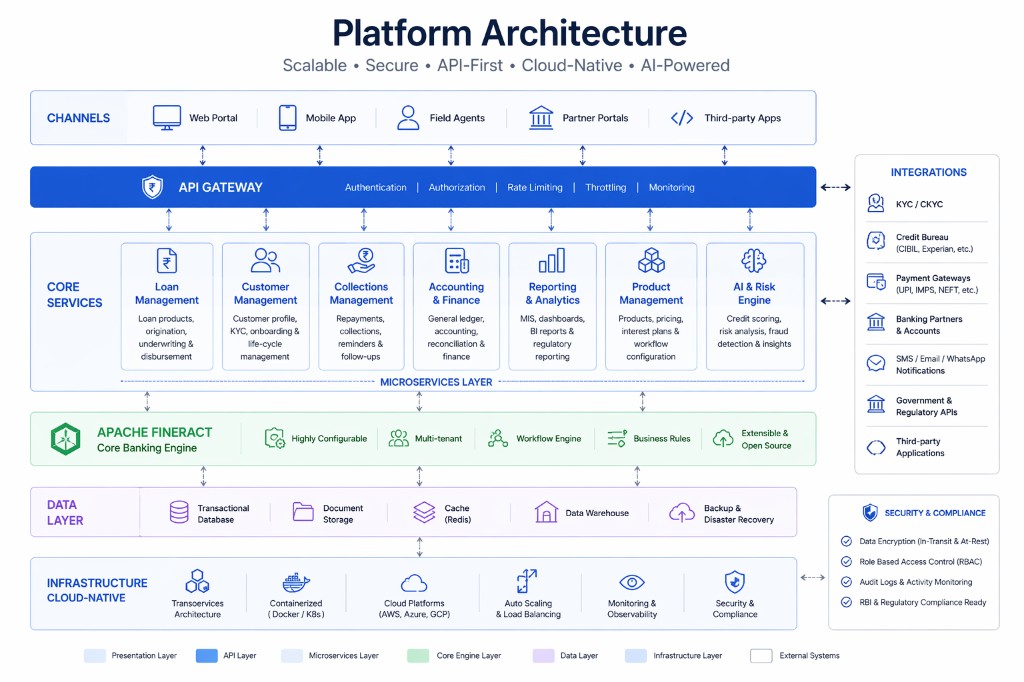
The market offers a variety of Microfinance Software solutions ranging from open-source Core Banking platforms such as Mifos powered by Apache Fineract to commercial enterprise solutions that provide integrated lending, accounting, mobile banking, and digital financial services. Each platform differs in architecture, deployment model, customization capabilities, pricing, scalability, API support, and implementation approach.
Modern Microfinance Software integrates with Loan Origination Systems (LOS), Loan Management Systems (LMS), Core Banking Systems, Banking APIs, Digital Onboarding platforms, payment gateways, mobile banking applications, Customer Relationship Management (CRM) platforms, analytics tools, and cloud infrastructure to deliver seamless financial services.
This guide compares Microfinance Software across functionality, architecture, deployment, integrations, security, compliance, scalability, implementation, and business value to help MFIs, NBFCs, SACCOs, Credit Unions, Cooperative Banks, NGOs, Rural Finance Institutions, and Financial Inclusion Programs make informed technology decisions.
Whether you are replacing legacy software, implementing a new Core Banking platform, or expanding digital lending services, this comparison will help identify the features and capabilities that matter most.
Internal Link:
https://intelligrow.co/blog/microfinance-software/
What is Microfinance Software?
Microfinance Software is a specialized banking platform designed to manage financial services for microfinance institutions and community-based financial organizations.
Typical capabilities include:
- Customer Management
- Loan Origination
- Loan Management
- Savings Accounts
- Fixed Deposits
- Group Lending
- Individual Lending
- Accounting
- Collections
- Reporting
- Mobile Banking
- Agent Banking
- Digital Payments
The software helps automate day-to-day operations while improving operational efficiency and customer service.
Internal Link:
https://intelligrow.co/blog/core-banking-software/
Why Comparing Microfinance Software Matters
Selecting the wrong software can result in:
- Higher operational costs
- Limited scalability
- Difficult integrations
- Slow product launches
- Regulatory compliance challenges
- Poor customer experience
- Increased maintenance expenses
A structured comparison helps institutions choose software that aligns with business goals and future growth plans.
Key Features to Compare
When evaluating Microfinance Software, institutions should assess:
- Loan Management
- Savings Management
- Group Lending
- Individual Lending
- Customer Management
- Accounting
- Mobile Banking
- API Integration
- Digital Onboarding
- Reporting & Analytics
- Security
- Compliance
- Cloud Deployment
- Scalability
- Vendor Support
Microfinance Software Comparison Matrix
| FeatureOpen-Source Platforms (e.g., Mifos)Commercial Platforms | ||
| Licensing | Open Source | Commercial License |
| Initial Cost | Lower | Higher |
| Software License Fees | None | Annual License / Subscription |
| Customization | Extensive | Vendor Governed |
| Source Code Access | Full Access | Closed Source |
| API Support | REST APIs | Enterprise APIs |
| Cloud Deployment | Supported | Supported |
| Mobile Banking | Supported | Supported |
| Vendor Lock-In | Lower | Higher |
| Community Support | Available | Limited |
| Enterprise Support | Through Partners | Vendor Managed |
The right choice depends on business priorities, technical capabilities, and long-term strategy.
Loan Management Comparison
An effective Microfinance Software solution should support:
- Individual Lending
- Group Lending
- Joint Liability Groups (JLG)
- Self-Help Groups (SHG)
- Agricultural Loans
- SME Loans
- Consumer Loans
- Loan Restructuring
- Collections
- Delinquency Management
Automated loan management improves repayment tracking and portfolio quality.
Savings & Deposit Management
Savings products remain a core offering for many MFIs.
Key capabilities include:
- Savings Accounts
- Fixed Deposits
- Recurring Deposits
- Interest Calculation
- Passbook Management
- Transaction History
Integrated savings management helps institutions diversify financial services.
Customer Management
A robust customer management module should include:
- Customer Profiles
- KYC Records
- Identity Verification
- Household Relationships
- Group Membership
- Contact Information
- Customer History
Centralized customer data improves service quality and operational efficiency.
Digital Lending & Loan Origination
Modern Microfinance Software increasingly supports:
- Digital Applications
- eKYC
- Document Upload
- Automated Underwriting
- Credit Assessment
- Loan Approval Workflow
- Digital Signatures
- Loan Disbursement
Digital lending reduces processing time while improving borrower experience.
Internal Link:
https://intelligrow.co/blog/digital-lending-transformation/
Mobile Banking & Field Operations
Many MFIs operate in remote and rural locations.
Modern solutions support:
- Mobile Banking
- Agent Banking
- Offline Data Capture
- Field Collections
- Customer Self-Service
- Loan Applications
- Balance Enquiries
Mobile capabilities improve operational efficiency and financial inclusion.
API & Integration Comparison
Microfinance Software should integrate with:
- Core Banking Systems
- Loan Origination Systems (LOS)
- Loan Management Systems (LMS)
- Banking APIs
- Payment Gateways
- CRM Platforms
- Digital Onboarding
- Mobile Banking Apps
- Analytics Platforms
- Accounting Systems
API-first architecture enables seamless integration with the broader banking ecosystem.
Advantages of Modern Microfinance Software
Organizations invest in modern Microfinance Software because it provides:
- Faster Loan Processing
- Improved Customer Experience
- Automated Accounting
- Better Portfolio Monitoring
- Regulatory Reporting
- Cloud Readiness
- Workflow Automation
- Scalable Banking Operations
Common Challenges
Organizations should consider:
- Data Migration
- Staff Training
- Process Reengineering
- Integration Planning
- Security Configuration
- Regulatory Compliance
- Change Management
A well-planned implementation strategy significantly improves project success and long-term software adoption.
Internal Link:
https://intelligrow.co/blog/core-banking-modernization/
Total Cost of Ownership (TCO): Microfinance Software Comparison
Selecting the right Microfinance Software requires evaluating the Total Cost of Ownership (TCO) rather than focusing only on the initial purchase or implementation cost. TCO includes software licensing, implementation, infrastructure, customization, integrations, maintenance, upgrades, support, training, and long-term operational expenses.
Open-Source Microfinance Software Cost Structure
Typical investment areas include:
- Business Process Analysis
- Solution Architecture
- Software Implementation
- API Integrations
- Data Migration
- Cloud Infrastructure
- User Training
- Managed Support & Maintenance
Open-source platforms generally eliminate recurring software licensing fees, allowing institutions to invest more in innovation and digital transformation.
Commercial Microfinance Software Cost Structure
Typical investment areas include:
- Software Licensing
- Annual Maintenance Contracts (AMC)
- Subscription Fees
- Vendor Implementation Services
- Infrastructure
- Professional Consulting
- Integration Services
- Upgrade Projects
- Vendor Support
Commercial solutions often provide enterprise support but may involve higher long-term ownership costs.
Cloud vs On-Premise Deployment
Deployment strategy directly impacts scalability, operational efficiency, and business continuity.
Cloud Deployment
Cloud-based Microfinance Software supports:
- Public Cloud
- Private Cloud
- Hybrid Cloud
- High Availability
- Disaster Recovery
- Automated Backup
Cloud deployment enables institutions to scale operations quickly while reducing infrastructure management.
On-Premise Deployment
On-premise deployments provide:
- Direct Infrastructure Control
- Internal Data Center Management
- Custom Network Configuration
- Dedicated Hardware Resources
Organizations must manage infrastructure, hardware upgrades, security, and disaster recovery internally.
Scalability Comparison
Microfinance institutions require software that grows with their customer base and lending portfolio.
Modern Microfinance Software Scalability
Modern platforms support:
- Multi-Branch Operations
- Multi-Currency
- Multi-Language
- Multi-Tenant Deployments
- Cloud-Native Scaling
- API-Based Expansion
Scalable software enables institutions to introduce new financial products without major architectural changes.
Legacy Software Scalability
Older systems may support:
- Limited Branch Expansion
- Basic Lending Products
- Traditional Infrastructure
- Manual Capacity Planning
Growth often requires infrastructure upgrades and extensive customization.
Security Comparison
Protecting customer and financial information is critical for every financial institution.
Identity & Access Management
Modern Microfinance Software should support:
- Multi-Factor Authentication (MFA)
- Role-Based Access Control (RBAC)
- Single Sign-On (SSO)
- Password Policies
- Session Management
These controls reduce unauthorized access and strengthen operational security.
Data Protection
Recommended capabilities include:
- Encryption at Rest
- Encryption in Transit
- Secure API Authentication
- Database Encryption
- Backup Encryption
Security effectiveness depends on implementation, governance, monitoring, and operational practices.
Audit & Monitoring
Comprehensive audit functionality should include:
- Customer Activities
- Loan Transactions
- Savings Transactions
- User Access
- Configuration Changes
- Administrative Activities
Audit logs support regulatory compliance and operational transparency.
Regulatory Compliance
Microfinance institutions must comply with financial regulations applicable to their operating jurisdictions.
Typical compliance capabilities include:
- Know Your Customer (KYC)
- Electronic KYC (eKYC)
- Anti-Money Laundering (AML)
- Customer Due Diligence (CDD)
- Data Privacy Regulations
- Financial Reporting
- Audit Trail Management
- Applicable Central Bank or Financial Authority Guidelines
Compliance depends on software configuration, governance, internal controls, and operational processes.
How to Evaluate Microfinance Software
Before selecting a platform, institutions should evaluate several key areas.
Business Requirements
Document:
- Loan Products
- Savings Products
- Group Lending
- Branch Operations
- Regulatory Requirements
- Reporting Needs
Technical Architecture
Evaluate:
- Cloud Readiness
- API Support
- Mobile Banking
- Integration Capabilities
- Scalability
- Performance
Vendor & Partner Expertise
Review:
- Banking Experience
- Implementation Methodology
- Support Services
- Product Roadmap
- Industry References
An experienced implementation partner can significantly improve project outcomes.
Future Growth
Ensure the software can support:
- Additional Branches
- New Lending Products
- Mobile Banking
- Digital Payments
- Analytics
- AI Integration
- Open Banking Initiatives
Selecting software that supports future growth helps protect long-term technology investments.
Why Choose Intelligrow for Microfinance Software Implementation?
Successful Microfinance Software implementation requires expertise in banking operations, digital lending, cloud infrastructure, APIs, cybersecurity, and regulatory compliance.
Intelligrow helps MFIs, NBFCs, SACCOs, Credit Unions, Cooperative Banks, NGOs, Rural Finance Institutions, and Financial Inclusion Programs implement scalable digital banking solutions.
Our services include:
- Microfinance Software Implementation
- Mifos & Apache Fineract Consulting
- Core Banking Modernization
- Loan Origination System (LOS) Implementation
- Loan Management System (LMS) Implementation
- Banking API Development & Integration
- Mobile Banking Solutions
- Digital Onboarding
- Cloud Deployment & DevOps
- Security & Compliance Consulting
- Data Migration
- Managed Support & Maintenance
We help financial institutions automate operations, improve customer experiences, strengthen compliance, and build future-ready digital banking ecosystems.
Microfinance Software Evaluation Checklist
| ActivityStatus | |
| Business Requirements Documented | ☐ |
| Loan Products Defined | ☐ |
| Savings Products Reviewed | ☐ |
| Deployment Model Selected | ☐ |
| API Integration Requirements Identified | ☐ |
| Security Controls Evaluated | ☐ |
| Compliance Requirements Validated | ☐ |
| Data Migration Plan Approved | ☐ |
| Performance Testing Completed | ☐ |
| User Acceptance Testing (UAT) Completed | ☐ |
| Employee Training Conducted | ☐ |
| Production Go-Live Approved | ☐ |
| Post-Go-Live Support Planned | ☐ |
Conclusion
Modern Microfinance Software plays a critical role in helping financial institutions automate lending, savings management, customer onboarding, accounting, collections, and regulatory reporting. Whether selecting an open-source platform such as Mifos powered by Apache Fineract or a commercial enterprise solution, the decision should be based on business objectives, operational requirements, scalability, integration needs, regulatory compliance, and long-term technology strategy.
Open-source platforms provide flexibility, extensive customization, API-first architecture, and lower software licensing costs. Commercial solutions typically offer vendor-managed support, predefined enterprise capabilities, and structured service agreements. Both approaches can support successful microfinance operations when implemented correctly.
The best software is one that aligns with your institution's lending model, customer base, growth plans, and digital transformation goals.
Partnering with an experienced implementation specialist like Intelligrow helps ensure successful planning, implementation, integration, optimization, and long-term support, enabling institutions to deliver secure, scalable, and customer-centric financial services.
Useful Internal Links
Microfinance Software
https://intelligrow.co/blog/microfinance-software/
Core Banking Software
https://intelligrow.co/blog/core-banking-software/
Mifos Implementation Guide
https://intelligrow.co/blog/mifos-implementation-guide/
Apache Fineract Guide
https://intelligrow.co/blog/apache-fineract-guide/
Digital Lending Transformation
https://intelligrow.co/blog/digital-lending-transformation/
Cloud Banking
https://intelligrow.co/blog/cloud-banking/
Banking APIs
https://intelligrow.co/blog/banking-apis/
FAQ
Frequently asked questions
Key factors include loan management capabilities, savings products, group lending support, API integrations, cloud deployment options, scalability, security, compliance, reporting, mobile banking, implementation support, and Total Cost of Ownership (TCO).
About Intelligrow
Experts in Digital Lending & Core Banking
Intelligrow helps banks, NBFCs, microfinance institutions, fintechs and digital lenders modernize their technology using Mifos, Apache Fineract, digital lending platforms and core banking solutions.
Our team provides implementation, customization, migration, API integrations, cloud deployment and long-term support for financial institutions across multiple countries.